7-Pardeh is a Virtual Reality experience I have been developing as part of my final research-creation project titled Narrative Affordances of Scale in VR: Remediating Iranian Traditional Storytelling. I aimed to draw inspiration from and breathe new life into an almost extinct form of storytelling known as Pardeh-Khani (reading off curtains) by reimagining it within the immersive medium VR. Pardeh-Khani is a specific type of Naqqāli, Iran’s oldest dramatic performance art, which was inscribed on UNESCO’s List of Intangible Cultural Heritage in Need of Urgent Safeguarding in 2011. A narrator would stand before an illustrated curtain, or Pardeh, and recite the stories while acting out the characters depicted. This practice was commonly performed in traditional coffee houses, known as Qahveh-Khane.
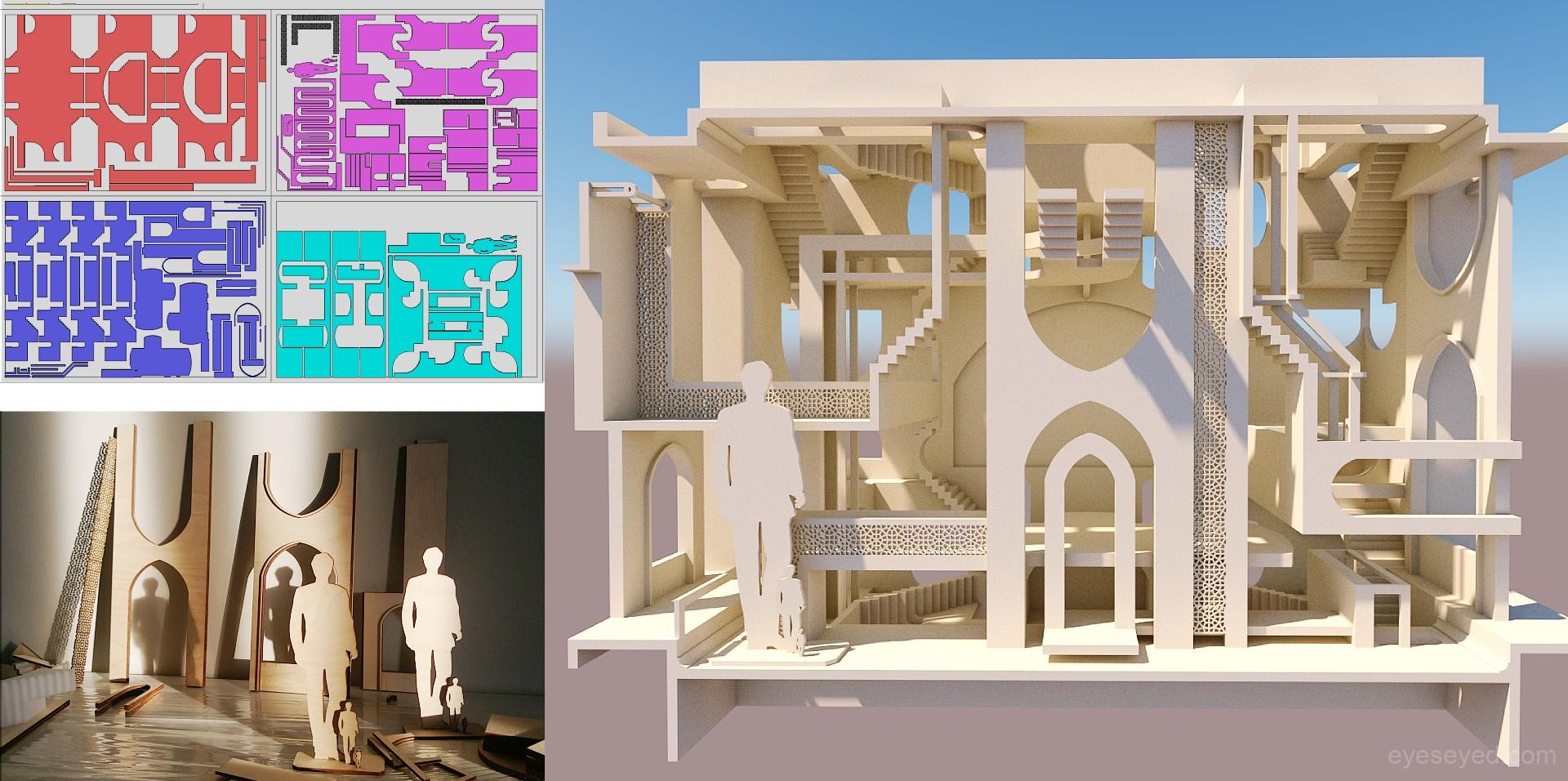
Adapting from the M.C. Escher’s Relativity (1953) and architectural elements of Qahveh-Khaneh, I designed a labyrinthine space which invites the experiencer to navigate different scales of virtual embodiment and follow a seven-act tale illustrated on variously sized and proportioned paintings. Through this project, I have been exploring how the VR-specific perceptual cues related to scale can offer unique storytelling experiences.
The full dissertation file is accessible from the following links:
Latest iteration of the VR experience will be available to download soon. Steam VR and a tethered HMD is required. This file was tested on Oculus Quest 2 via USB link cable.
Under Progress
This work is licensed under a Creative Commons Attribution 4.0 International License. Navigation Mechanics
2D/3D Artworks
The story of “Haft Khan-e Rostam” (Rostam’s Seven Trials) was chosen for this experience. It has been a popular Iranian folktale and a common subject of “Pardeh-Khani” paintings. “Rostam”, the persian hero accompanied by his unique horse “Rakhsh” embarks on a heroic journey of seven stages in order to free “Kay Kavus” (King of Persia) and other Persian paladins. Besides seven distinct segments of the story which facilitate its spatial composition over multiple “Pardehs” (Paintings) within the architectural space, this story is full of characters of various sizes. This was well in line with one of the objectives of this experiment which was to exploit the dramatic capacities of scale in relation to the characters. Additionally, I have been developing satirical story ideas that creatively twist the original narrative, aligning it to my ongoing concerns and interests regarding the implications of extensive use of social and immersive media.
Physical Research Exhibition
Acknowledgements
This project won the Hexagram Student Members Grant in 2018 and the monetary award greatly advanced bringing a number of collaborators on board in a professional fashion. Design and implementation of the navigation mechanic was done in collaboration with Mahdi Sadri. 2D/3D paintings were created with the help of my sibling Maryam Tabatabaei.
This project was also one of the winners of 2021 CUAA Fine Arts Prize.
Deepest gratitude to the members of Milieux Institute especially Marc Beaulieu, and members of Sensor Lab especially Elio Bidinost for the technical support and provided facilities. Heartfelt thanks to the members of Technoculture, Art and Games (TAG), especially Jonathan Lessard who supervised this research, also Pippin Barr, Rilla Khaled and Enric Llagostera for their constructive criticism and thought-provoking feedback along the way.
Thank you to Simin Farrokh Ahmadi for loving me and professionally supporting my projects.